
Do you have a plan to start a business, or are you a business owner? Have you ever thought that marketing is useless? If so, then this is for you.
If you have a good product that has high demand in the market, thinking that you don’t need to spend money on marketing is the biggest mistake. Just as a good product is essential for a business, how it is marketed is equally important. Good marketing not only helps your business grow but also saves your valuable time. While organic word-of-mouth reach can take months and years, a good marketing strategy can achieve it in just a few months.
The Myth of the Self-Selling Product
Let’s be honest, we all love the idea that a truly great product—a genuine ‘game-changer’—should simply sell itself. It’s a comforting thought, suggesting we can focus all our energy on innovation and quality without the messy, costly distraction of marketing.
But here’s the reality check: a great product is the engine; marketing is the fuel and the map. Without marketing, your brilliant product is just a secret you’re keeping from the people who need it most.
Think about it: in today’s crowded marketplace, consumers are bombarded with options. Your product might be superior, but if your competitor is louder, more visible, and more persuasive, they’re winning the customer, not you. Marketing is the process of getting noticed, building trust, and clearly articulating why your solution is the best choice. It’s about earning the right to an audience’s attention.
The Jio Example: A Strategy for Market Domination
For example, when the company Jio launched, they offered free unlimited internet and calling options. Everyone bought and used the Jio SIM, and later Jio started charging for their plans. Now, they are a major force in the telecom industry. Wasn’t it a good marketing strategy that helped them become the industry leader within a few years? You can see many such real-time examples.
Jio’s launch was a masterclass in strategic marketing, not just reckless spending. Their initial “free” offer was a massive customer acquisition campaign. They successfully removed the barrier to entry (cost/risk) and got their product into millions of hands, establishing a new behaviour and dependency on their high-speed network. When they finally started charging, they weren’t selling a new service; they were selling the continuation of a service customers had already integrated into their daily lives. That is the power of a bold, market-defining marketing strategy—it’s an investment in market share that pays exponential dividends.
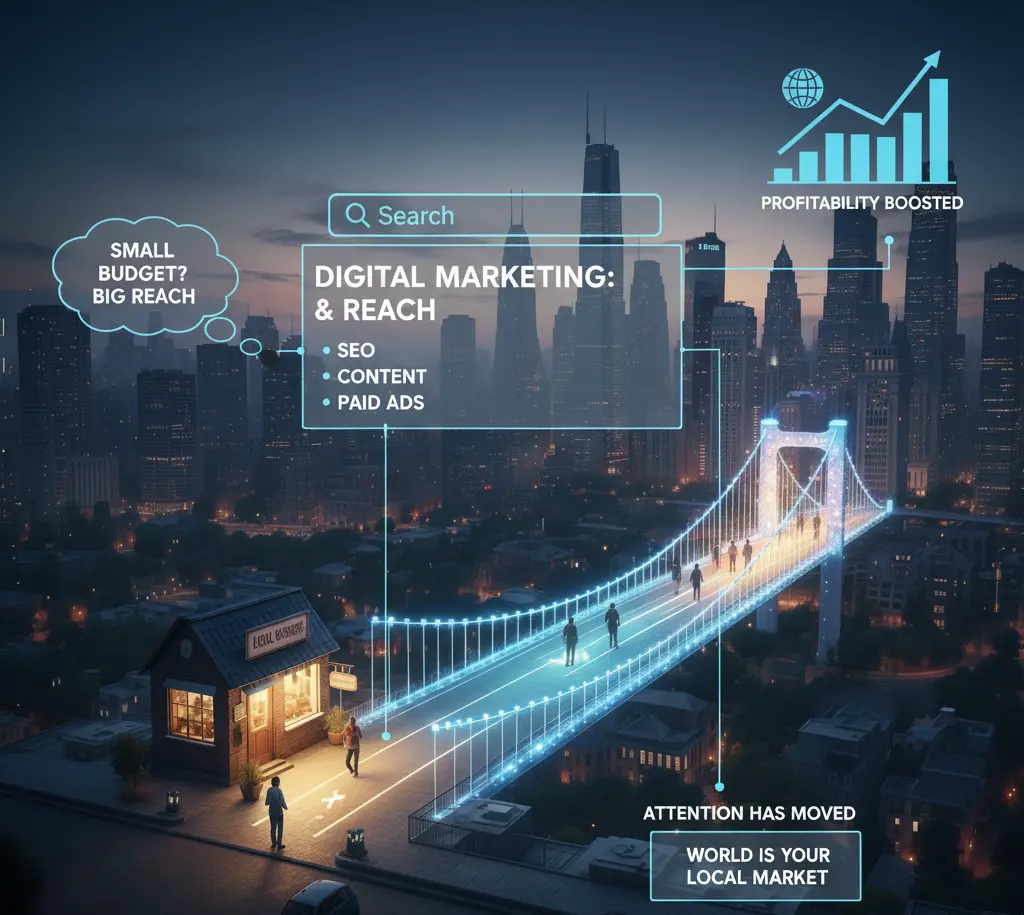
“But I’m Not Jio! I Have a Small Budget.”
This is the most common and critical question every small business owner asks. You see the massive ad spends of the big players and think, “They can afford that. How can I market effectively and affordably? ”
If marketing once belonged exclusively to those with deep pockets who could afford massive TV spots and billboard campaigns, the good news is that those days are over.
The answer is simple, powerful, and, most importantly, accessible: Digital Marketing.
Why Digital Marketing is the Game Changer
1. We Live on Our Phones (And So Does Your Audience): Let’s face it: our attention has moved. People aren’t glued to the TV or the radio anymore; they’re scrolling, searching, and sharing on their smartphones for hours every single day. If you want to talk to your customers, you have to go where they actually are—and that’s online.
2. Stop Shouting, Start Speaking Directly: Traditional advertising is like yelling your message into a crowded stadium, hoping the right person hears it. Digital marketing, however, is a direct conversation. It lets you be incredibly selective, reaching people based on their specific age, hobbies, what they’ve recently searched for, or even their neighborhood. It’s marketing that cuts through the noise and lands exactly where it needs to.
3. The World is Your Local Market: The internet has dissolved geography. Whether you run a small shop out of a tiny town or a service from a major city, digital platforms give you the power to connect with and sell to customers anywhere on the planet. Small businesses no longer have to think small.
4. Efficiency That Respects Your Wallet: You don’t need a huge, risky ad budget to get started. Digital marketing is accessible: you can begin with a small investment, see what works, and only then put more money behind the successful parts. You have total control over your spending and can consistently prove that your money is bringing in real results.
5. You Can See Exactly What’s Working: No more guessing games. With digital tools, you can track every single action: every view, every click, and every purchase. This hard, clear data allows you to constantly refine your message and adjust your budget, ensuring you’re always getting better returns on your investment.
Digital marketing isn’t just an option anymore; it’s the core fuel that drives business growth in the 21st century.
The Digital Marketing Toolkit: Organic vs. Performance
The toolkit is generally divided into two essential strategies: long-term, organic growth and short-term, paid performance.
1. The Long Game: Building Organic Authority
If you want organic reach for a product, this is about earning your attention, not buying it.
Search Engine Optimization (SEO): You can use SEO to improve website rankings. SEO involves optimizing your website content and technical structure so that search engines like Google understand what you offer and deem you the best answer to a user’s query. If our website ranks high, the chance of clicks is higher than for lower-ranking websites. This traffic, once you earn the rank, is essentially free and highly qualified.
Content Marketing: Additionally, you can attract the audience by posting blogs and good creative content on social media platforms. This helps you build a community and establish your brand as a helpful authority.
All this helps us reach the audience organically, but this is a long-term process. It’s the slow, steady work of building an asset that compounds over time.
2. The Quick Win: Driving Performance and Leads
If you want results quickly, you can use performance marketing tools. This is where you directly invest money to drive immediate action.
Paid Campaigns: By running paid campaigns on Google Ads and Meta Ads (Facebook/Instagram), you can directly target the desired audience and generate leads very efficiently and cost-effectively. You can target people who have searched for your exact product (Google Ads) or who fit your ideal customer profile (Meta Ads).
Measurability and Optimization: The beauty of performance marketing is that it’s completely measurable. You know exactly how many clicks, leads, or sales came from every dollar spent. This allows you to constantly refine, test new ideas, and instantly stop the campaigns that aren’t working—maximizing the return on your investment.
Conclusion
In today’s competitive world, digital marketing is indispensable. It’s not a drain on resources; it’s the most powerful tool for efficient growth. It eliminates the guesswork, focuses your spending, and allows even the smallest player to compete globally.
We can say without a doubt that it greatly helps our brand’s growth and profitability. It transforms your great product from a hidden gem into a highly visible, trustworthy market leader. Start Your Growth Journey Now!